
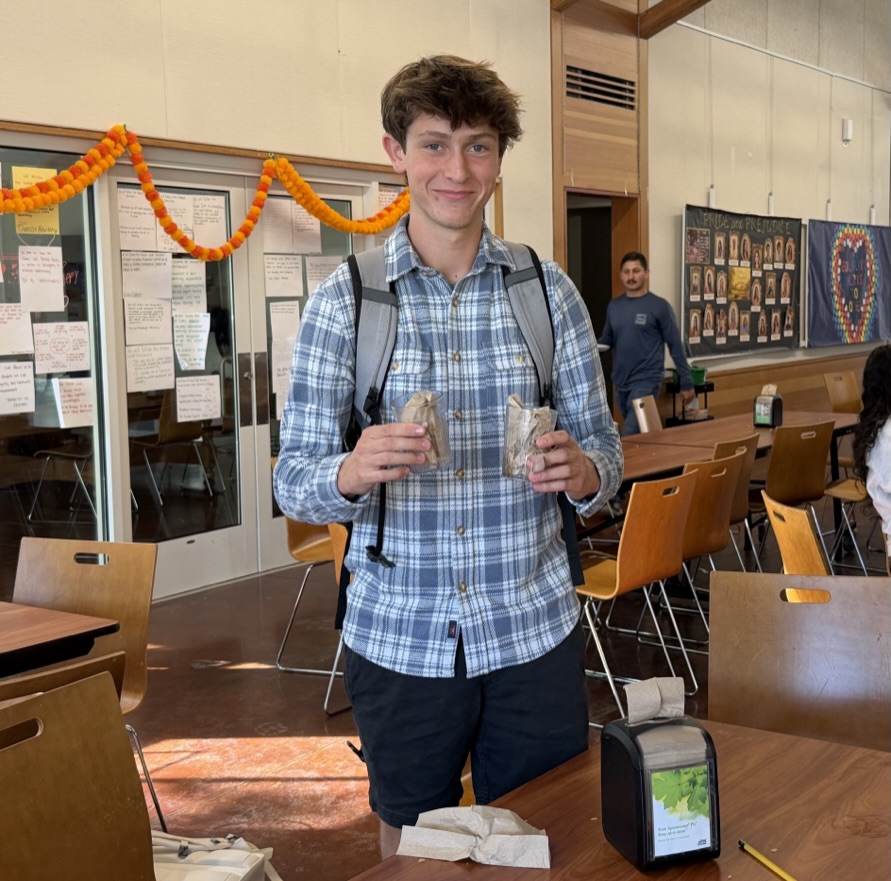
Branson students have long grappled with a way to keep the Commons, our cafeteria and a great gathering place, clean. This struggle raised a larger question concerning the student body: What does our inability to clean up after ourselves during lunchtime reveal about our willingness to fully contribute to Branson’s community?
To answer this question, we determined that while Branson students are eager to engage with their community in other arenas, such as starting clubs, participating in class discussions and communicating with their teachers, this self-awareness falls short during lunchtime.
After each lunch period, food and plates litter the Commons, creating a dirty environment that no one wants to study or hang out in. Ultimately, the responsibility to clean up falls to a small number of people, especially the kitchen staff. Branson students have no intention to be rude to the kitchen staff, but this behavior shows us that Branson students are picking and choosing when they wish to fully contribute to improving the Branson community.
After numerous attempts to solve this issue have failed, including a reward system and a lifeguard tower, Branson has formulated a new plan. Each day, two seniors are assigned to clean up the Commons, which is then assessed after the lunch period by the Branson kitchen staff. If the Commons is clean, the Branson community will receive an enthusiastic thumbs-up. However, if the Commons is dirty, senior privileges will be revoked for the next day.
This new plan has proved to be extremely successful. As of the time of printing, Dec. 3, the Commons has not received a “thumbs down.” While this new plan appears to be a practical solution to the Commons’ cleanliness and encourages seniors to step up in the community, it sets a precedent for senior privileges to be used as a bargaining tool in the future and focuses on localized punishment rather than encouraging students to pitch in and help the community. Moreover, by targeting seniors, this new strategy intensifies student power dynamics between upperclassmen and underclassmen by using fear of upsetting seniors to incentivize good habits.
While the only punishment that will result from a dirty Commons space is the revocation of senior privileges, the underclassmen and juniors also dine in the Commons and contribute to its cleanliness, so if the seniors receive punishment, they should also be punished.
As an ideal long-term solution, Branson should consider combining the punitive approach of the current strategy with a more community-oriented approach. For example, a revised plan could expand the daily lunch leadership to involve juniors and seniors, encouraging all upperclassmen to lead.
Also, an improved plan might shift the punishment so that the Commons’ cleanup affects the entire student body, rather than just seniors, restricting Snack Shack privileges, for example. Furthermore, Branson should couple the punishment system with a reward system to incentivize good behavior and initiative. One idea might include receiving treats in the Commons if students keep it clean for two weeks in a row.
In short, to improve the current strategy and build a stronger sense of community, Branson should shift responsibility for the Commons’ cleanliness away from just seniors and toward the whole student body. A balanced system that includes both collective rewards and fair consequences would motivate everyone to take part.
Cleaning up shouldn’t just be about avoiding punishment, but reflecting the pride in our shared space. Ultimately, a clean commons isn’t just about tidiness; it’s about showing respect for the people and place that define the Branson community.
![[“The Millionaire Next Door” by Thomas J. Stanley and William D. Danko]](https://theblazer.news/wp-content/uploads/2026/04/Screenshot-2026-04-20-at-12.04.32-PM.png)

